The PlayingPast project aims to review the weight of video games in culture and, more specifically, in the experiences that recreate historical knowledge in museums. Hand in hand with technology, gamification has been fighting a long battle to break the barrier of traditional mentalities and to introduce interactive resources in the galleries of history museums.
An interesting example could be the Battle of Stirling Bridge game, which has been recreated in one of the main rooms of the Museum that contextualizes the William Wallace Monument near Glasgow, Scotland. Many other attempts at gamification (from the simplest interactive games to the most serious proposals, in very different technological formats including video games, VR and AR), are being progressively incorporated into the halls of the tempos of culture.
One of the controversies on the table is the relationship between the efficiency of this type of resources and their sustainability, which require a strong initial investment and costly maintenance. Not to mention something very significant also in the world of museums, which is the loss of space with respect to collections always eager to leave the warehouses; as well as the aesthetic rupture of spaces with the irruption of these high-impact resources. It is obvious that the great demand from the public is in their favor, but it is no less true that these resources have the unfinished business of demonstrating that they can generate significant knowledge, beyond mere entertainment. To make sure that the first part of the word ‘Edu-tainment’ (with which we refer to these informal learning environments, which has to do with their ‘education’ aspect, as opposed to the ‘entertainment’ part), still has little evidence of reliable scientific work.
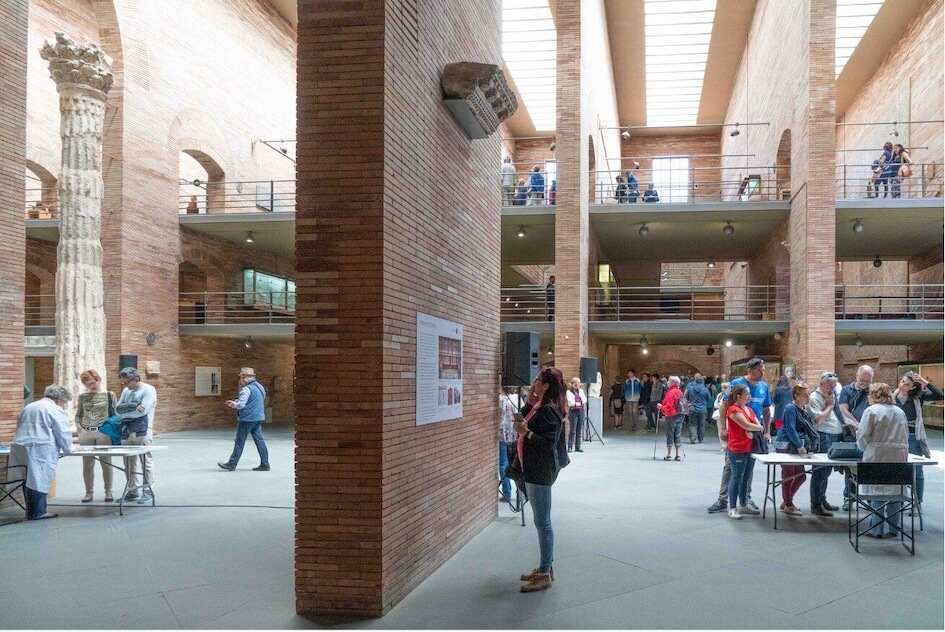
In the PlayingPast project we intend to carry out a workshop experience by putting into dialogue two contexts of informal education intervention: a video game club in the city of Merida and a very “serious” museum, the National Museum of Roman Art, on the basis of one of the most famous games. And what is more important in this context, more rigorous, about the Roman world.
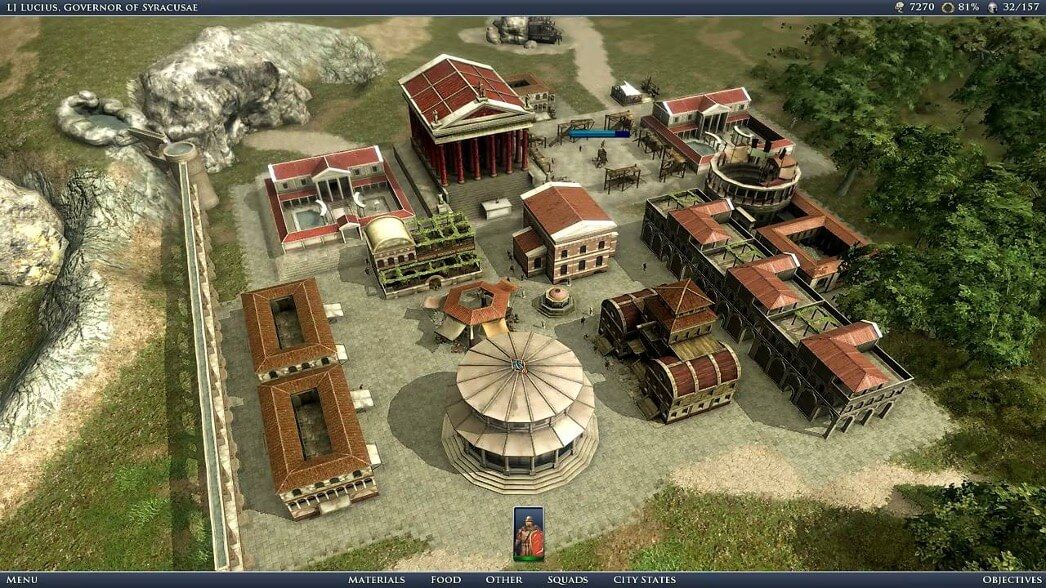
The game chosen for the workshop at the video game club will be ‘Grand Ages: Rome II’, which is one of the most complete strategy games on the commercial market, where players must work together to defend the empire from constant barbarian attacks. With a large amount of additional material, it is a tactical as well as constructive game, which is said, according to its creators, to provide a global reflection on the Roman Empire and its time.
‘Grand Ages: Rome’ (also known as Imperium Romanum 2) is a 2009 real-time strategy and city-building game developed by Haemimont Games and published by Kalypso Media. It is the sequel to Imperium Romanum from 2008. The Italian and Spanish versions of the game are titled Imperivm: Civitas III. A sequel, Grand Ages: Medieval, was released on September 25, 2015.
The single-player campaign is set during the final years of the Roman Republic during the time of the First Triumvirate. The player undertakes missions for his family, establishing a reputation as a statesman and leader, as well as working under the orders of historical figures such as Marcus Tullius Cicero, Mark Antony, Pompey Magnus and Marcus Licinius Crassus. Certain historical events are portrayed, such as the slave uprising led by Spartacus and the crossing of the Rubicon. At any given time, the player must choose between allying with Julius Caesar or Pompey Magnus, and the missions consist of eliminating the Optimates or building armies against the Populares.
With a beginning that allows each player to customize themselves, the game focuses on macro-management. Each mission involves building a Roman colony in various locations in the Roman Republic, with certain requirements and additional objectives to successfully complete the mission. There is an emphasis on efficiency and employment, ensuring that all buildings are staffed by the appropriate class of workers.
Resources are based on a “flow” economy, where the player does not actually accumulate a stockpile of resources, but rather develops the infrastructure to construct and maintain buildings. To obtain more resources, players can choose to build communities on the map, engage in trade, or purchase property, which remains with the character throughout the campaign.
Players must keep citizens happy through satisfactory levels of food, religion and entertainment. Building benefits work on a radius system, where buildings provide their bonuses or need other materials within a certain distance. The player can build important monuments for large or global bonuses, such as the Colosseum, the Circus Maximus and the Pantheon. When players fail to meet the needs of their citizens, crime and disease can spread and houses can be abandoned, which can cause a chain reaction in the shortage of goods and services.
In the empirical part of the project the plan is to have an experimental group practice with the video game for weeks, and a pre/post control, on a battery that measures historical thinking (that we are generating), will allow us to detect if there are improvements compared to a control group, who will not practice the game, but a set of activities on cinema and historical novels of the same historical period. Finally, there will be an activity in the museum (MNAR) that will allow us to observe if the participants are able to apply this knowledge to a real context of informal learning in the museum.
As the inductor of the gaming experience we have the gentleman who appears below, looking like a Persian prince, who has a name that sounds like an emperor, Manuel Alejandro Torres Caldera, not in vain he was born in Emerita Augusta, in the noble first century of the digital era. He graduated in biological sciences, determined that CyberRobots will need an organic heart. He is a copywriter, project manager and developer, full-time joker and entrepreneur by accident. The workshop would take place in his private club (Emerita comics). He is a great connoisseur of the comic and videogame world, and he got excited about the project with the same spontaneous enthusiasm as children tear the wrapping off a new toy.

(*) The PlayingPast project (www.playingpast.net) aims to study the influence of historical video games in the construction of historical thinking and, in short, in the learning of History, within the framework of the general reflection between Technology, Education and Culture, both in the formal classroom and in informal learning, such as the world of museums. Four main lines of work are being developed within the project. Two theoretical: one, the review of the scientific literature of the works developed so far, and two, the discussion among experts in a series of meetings, which will take place in Cyprus, next November, and in Madrid, in March. And two empirical: a workshop experience in the classroom and a mixed workshop experience in the informal context of a video game club and a museum.